
Stories relating to science and the environment
Wednesday, June 10, 2015


Thursday, May 28, 2015
Conservation terms that describe species

Keystone
Species:
A keystone species plays a
crucial role in the functions of a healthy ecosystem. Without them, the system would be drastically
altered or even cease to exist. The contributions of a keystone species are
large and doesn’t always match the species’ prevalence in the habitat.
If a keystone species
disappears; a domino effect begins to happen and other species that rely on
that keystone, would change. One example would be if a large predator is
removed from a system where deer lived; deer populations could explode. The ecosystem cannot support that many
animals. Competition for food and other resources would result among the deer themselves; their populations would
decline and overall fitness levels would lower in the herds.
You can read an article
published on Huff Post that discusses this issue further by clicking this
link.
Foundation Species
Foundation species have major role in maintaining or even creating
a habitat that supports other species. A great example of this would be corals.
Corals produce the reef structures that countless species live and depend on.
Umbrella Species
An umbrella species is very similar to a keystone species. Many
umbrella species are migratory and their daily activities help shape and
maintain a balance to the ecosystem. By protecting an umbrella species, you are
automatically protecting a number of other species who rely on that particular
species.
Indicator Species
An indicator species is very sensitive to environmental changes
in its ecosystem. By monitoring these species, conservationist can get early
warning signs of habitat changes. External influences from changes in air,
water or climate present themselves to these indicator species first.
Reference: National
Geographic

Monday, May 18, 2015
Understanding infectious diseases
Understanding how
infections and diseases spread can be very challenging. Here are some terms
that can help. (Medecinenet.com)
Infection: The invasion and multiplication of
microorganisms such as bacteria, viruses, and parasites that are not normally
present within the body. An infection may cause no symptoms and be subclinical,
or it may cause symptoms and be clinically apparent. An infection may remain
localized, or it may spread through the blood or lymphatic vessels to become
systemic (bodywide). Microorganisms that live naturally in the body are not
considered infections. For example, bacteria that normally live within the
mouth and intestine are not infections.
Reservoir of infection: Any person, animal, plant, soil or substance in
which an infectious agent normally lives and multiplies. The reservoir typically
harbors the infectious agent without injury to itself and serves as a source
from which other individuals can be infected. The infectious agent primarily
depends on the reservoir for its survival. It is from the reservoir that the
infectious substance is transmitted to a human or another susceptible host.
Many infectious agents have the ability to infect more than
one host species, making it very difficult to track. 62% of all human pathogens
are classified as zoonoses. The pathogens that infect livestock are 77% zoonotic.
Fifty seven of the seventy animal diseases that are considered to be of
greatest importance infect multiple hosts. These multi-host pathogens are hard
to control and it is important to understand the term reservoir of infection.
Often,
emerging human or wildlife diseases are assumed to be maintained in a reservoir
host; but are rarely defined. The control efforts are often directed toward “Suspected
reservoir populations”. Reservoirs that
harbor Ebola are still unknown, making it difficult to eradicate the disease (Hayden, et. al, 2002).
If you are interested in this topic; you can read further by
looking at this article:
Haydon, D., et. al., 2002. Identifying Reservoirs of
Infection: A Conceptual and Practical Challenge. Emerging Infectious Disease.
Vol 8(12). 1468-1473.
Students can also search on Searchwise to
find similar articles.
Monday, April 13, 2015
Swamp day
The honors field biology class had a swamp day filled with canoes, alligators, mosquitoes and a brief overview of the natural history of the Grassy Waters Nature Preserve in West Palm Beach , FL.
The class took canoes to a small island in the middle of the preserve and got out and went mucking in the mud to learn new things about what makes up the Everglades.
Here are some pics of the students having a great time!


The class took canoes to a small island in the middle of the preserve and got out and went mucking in the mud to learn new things about what makes up the Everglades.
Here are some pics of the students having a great time!
Friday, April 3, 2015
A Quick visit to the Marinelife Center
The field biology class from the Wilkes Honors College took quick visit to the Marinelife Center in Juno Beach, FL, to learn about sea turtle monitoring and rehabilitation. Dr. Charles Manire and his field team gave a question and answer session; and then the class went out to learn about the rehab patients.
Many students, in the past, have done their senior theses on sea turtles, and a few are investigating the possibility for upcoming projects.
Here are some of the students out in the turtle yard.


Many students, in the past, have done their senior theses on sea turtles, and a few are investigating the possibility for upcoming projects.
Here are some of the students out in the turtle yard.
Monday, March 30, 2015
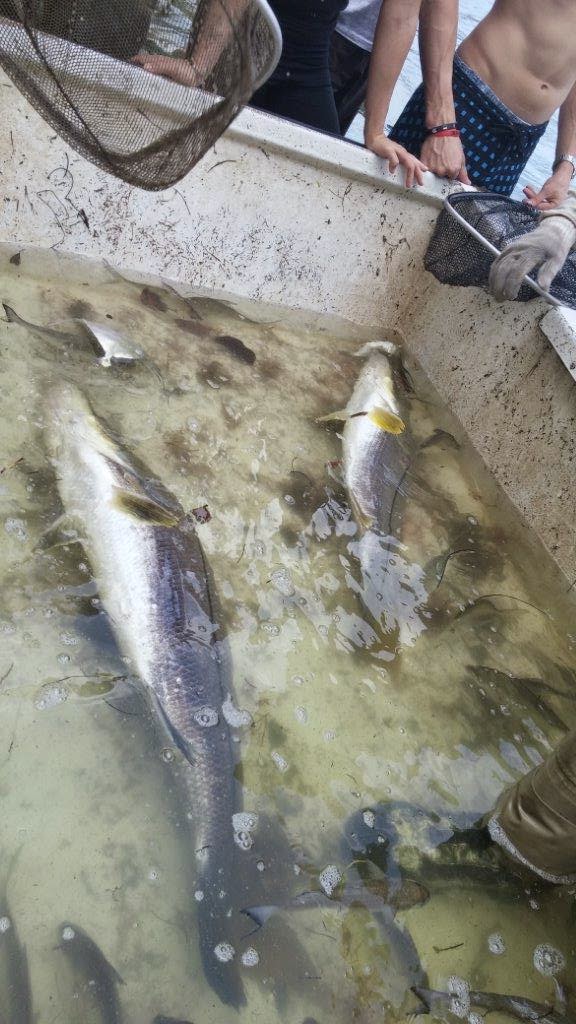
Honors Field Biology Class learns about fish surveys
The BSC4930 Honors
Field Biology class visited the Florida
Fish and Wildlife Conservation Commission’s (FWC) Tequesta Field
Lab. Biologists gave the class an
overview of the importance of conducting randomized
sampling on fish populations; and prepared the class to
participate in a sample survey.
FWC’s Fish and Wildlife Research Institute conducts this research in order to estimate fish abundance and population trends in seven regions around Florida. You can read all about it here.
FWC’s Fish and Wildlife Research Institute conducts this research in order to estimate fish abundance and population trends in seven regions around Florida. You can read all about it here.
Jim Whittington led the trip with help from JJ
Brodbeck, Anderson Berry and Beau Yeiser. Joy Young helped out at the lab.
Here are several images of our time in the water. Please note, all of the fish were released back into the water after measurements and counts were taken. Thanks to FWC (and Dr. Tom Reinert) for the great learning
experience.
Here are several images of our time in the water. Please note, all of the fish were released back into the water




Friday, March 20, 2015
Field biology back to measure thermoregulation of gopher tortoises
The Honors college Field biology class (taught by Professor James Wetterer) was back in the Abacoa Greenway with Dr. Wetterer and Dr. Jon Moore, conducting research on a student thesis project. The class took body temperatures of the tortoises and the temperature of the air and burrows.
Here are a few images of students in the "Turtle soup(ers) [or supers] group" named by the team leader of the group.


Here are a few images of students in the "Turtle soup(ers) [or supers] group" named by the team leader of the group.
Subscribe to:
Posts (Atom)