Showing posts with label FAU. Show all posts

Friday, April 6, 2018

Field trip to Pine Glades Natural Area

The Field biology class took a field trip to Pine Glades Natural Area for a swamp buggy tour and two field survey activities led by staff biologists.

The biologists let students participate in some of their management/monitoring activities . One group learned how to do line transect plant surveys, monitoring plant abundance. They spoke about the different methods of habitat restoration [mechanical, chemical and fire]. This location uses a combination of all three methods in order to restore and maintain natural habitats. Along with methods, students learned about community, agency and cooperative efforts that all play an important role in which method is used and when, along with overviews of all the permits and permissions required for maintaining natural habitats.

The second group of students learned how to use throw nets to survey and record what is living in the waters of the park. In this case, the "net" was netting on a square pvc cube that was placed to isolate sections of water. They then sieve out the water to see what species  are found. They record and continue this method until there are no more fish or arthropods in the net, then move on to another section. They found shrimp, crayfish and several fish species.

Along the swamp buggy tour students saw nesting  great white herons, swallowtail kites and even feral hogs. We have the pictures to prove it! Thanks to our hosts for another great field trip.


Wednesday, March 14, 2018

Dupuis Management Area field trip

Recently Wilkes Honors College Faculty went on a tour of The Dupuis Managent Area to investigate possible research opportunities for students.

The DuPuis Management Area is a 21,875-acre multi-use natural area located in northwestern Palm Beach and southwestern Martin counties. The property is interspersed with numerous ponds, wet prairies, cypress domes, pine flatwoods and remnant Everglades marsh. The area provides miles of hiking and horseback trails, an equestrian center, graded vehicle roads, backpack and group campsites and seasonal hunting. DuPuis is far from urban areas, and its dark night sky lends itself to excellent stargazing.


Kim Elliot, the Education and Training Coordinator for CES/FAU located at Dupuis, along with Loisa Kerwin, Assitant Director for CES/FAU gave a short presentation on the history, ecology and activities that are available at Dupuis. They highlighted the research done on the Red Cocaded Wooddpecker by The Florida Freshwater Fish and Wildlife Commission (FWC) scientist, Valerie Sparling. You can read about that here.


They treated us to a SWAMP BUGGY RIDE so we could get a close up view of the different habitats on the property. Here are a few shots of us preparing for the journey.


If you have never experienced a swamp buggy, don't worry I took video!


Dupuis is a great resource for so many acitivities. Here are a few more pics of the day. We got out and walked throught the cypress swamp. You can see the water line on the trunks of the trees. There is also a close up of the Florida Apple snail.


To end our tour we stopped at the public campground area. There are remnants of history there with the old hunting camp owned by John G. and Susan H. DuPuis, Jr. If you are up for an adventrue this is a great place to start. 


Friday, January 26, 2018

Collecting Ant Specimens with Dr. Jim Wetterer


Last week we talked about the field biology class taught by Dr. James Wetterer. This week he took the class to FAU’s Pine Jog Environmental Education Center. Anne Henderson, the Director of Education, gave students an interactive introduction to the center and took us on a tour. It was very informative. Here are a few pics of that portion of the trip


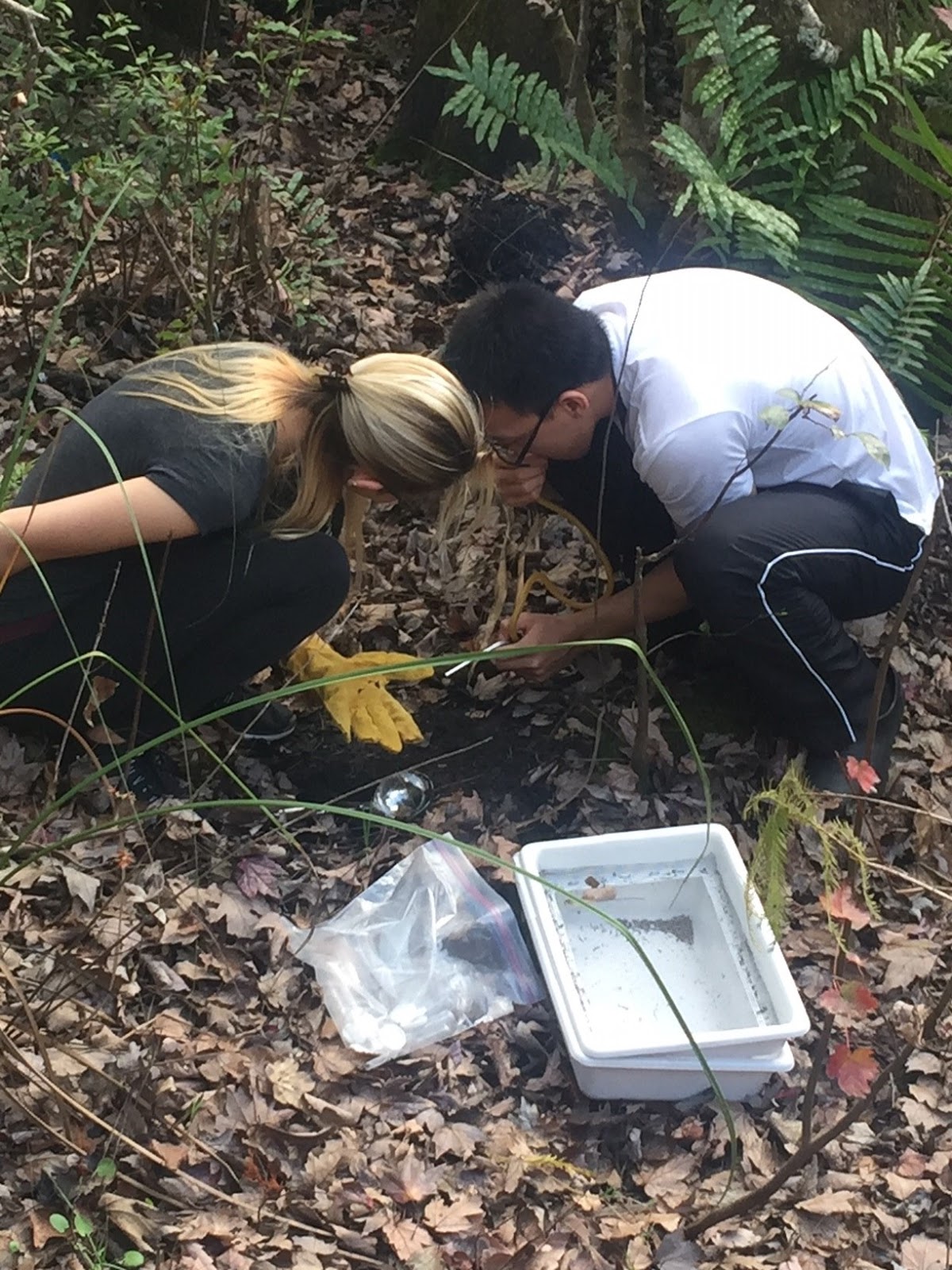
Students read peer reviewed articles, and discuss field topics in class. The next class is spent out in the field. This lab (field) class, students learned how to collect ant specimens throughout the property of the environmental center. They practiced specimen collection and identification. Once the ants were collected, Dr. Wetterer made the identifications.

Here are the students in action


 Now being a field biologist requires some flexibility, because sometimes things go wrong out there. You also need a sense of humor. Here is a prime example…one student [who will remain nameless] used the wrong end of the ant aspirator and ingested an ant or dirt [we can neither confirm nor deny this incident]!! He was fine and the rest of us got a chuckle.


It is a big property, and more than ants live there. Last year I was lucky enough to find an animal skull. This year students were on the lookout for another…They did not disappoint. If anyone can identify it, please comment. One student also got a great photo of a snake.


All in all it was a great learning experience and it is fun to see Dr. Wetterer in action. He is very passionate about ants and makes every trip a great adventure.

Tuesday, July 12, 2016

Manatee photo ID survey

Survey field notes: 7/8/2016 

Another manatee photo id survey was conducted at Harbor Branch Oceanographic Institute @ FAU at 1:45 pm – 2:20pm on July 8, 2016 with clear, sunny skies. One cow/calf pair was spotted in the channel. The pair were traveling along the seawall while nursing. They slowly crossed the channel into the shaded areas over by the submersible garage ramp.

No other animals were observed today. None were needed because there is nothing better than seeing a baby marine mammal. Here are the pictures to prove it! There is also a detail shot of the mother's tale fluke for identification purposes.


Thursday, July 7, 2016

Manatee Photo ID survey

The Manatee Research team at FAU’s Harbor Branch campus regularly conducts photo id/surveys on Florida manatee that frequent campus. The Harbor Branch channel plays a vital role as a thermal refuge, with >100 manatees congregated in the basin during recent winter cold fronts. The goal of this research is to develop an integrated system using existing (photo-identification) and new (remote sensing) techniques to continuously monitor manatee behavior and habitat.

For the next two weeks, the library’s staff science guy (or gal) will be conducting these surveys and posting about it here. You can also find the HBOI research team on facebook here. Find them and follow, so you can keep updated on all things manatee!


Survey field notes: 7/6/2016
The survey was conducted on July 6, 2016 from 2:00 pm – 2:30pm. One adult manatee was present in the HBOI channel [located close to the small boat marina at a day dock area]. The manatee was observed surface resting, with very little activity. Breaths were taken every few minutes; with little movement, most of the body of the manatee was submerged. No manatee were spotted in the second survey location.

Here are the photos.


What’s the deal with the algae all over the manatee? Here are some peer reviewed articles on the topic.

Interactions between non-native armored suckermouth catfish (Loricariidae: Pterygoplichthys) and native Florida manatee (Trichechus manatus latirostris) in artesian springs Leo G. Nico1*, William F. Loftus2 and James P. Reid1 1 U.S. Geological Survey, 7920 NW 71st Street, Gainesville, Florida 32653 USA 2 Aquatic Research & Communication, LLC, 1759 NW 20th St., Homestead, FL 33030 USA E-mail: LNico@usgs.gov (LGN), arc_wfl@bellsouth.net (WFL) * Corresponding author

The tanaid Hexapleomera robusta (Crustacea: Peracarida) from the Caribbean manatee, with comments on other crustacean epibionts. Benjamín Morales-Velaa1, Eduardo Suárez-Moralesa1 c1, Janneth Padilla-Saldívara1 and Richard W. Hearda. Journal of the Marine Biological Association of the UK / Volume 88 / Issue 03 / May 2008, pp 591-596

A COMPREHENSIVE SOLUTION TO THE BIOFOULING PROBLEM FOR THE ENDANGERED FLORIDA MANATEE AND OTHER SPECIES BY KATHLEEN D. OPPENHEIMER* AND TODD K. BENDOR. TOJCI.OPPENHEIMER.DOC

Here is some internet stuff on the topic:


Wednesday, June 22, 2016

The Manatee Project at Harbor Branch Oceanographic Institute


Did you know that scientists at the Harbor Branch Oceanographic Institute @FAU have a program that keeps track of manatees that frequent campus?

Since the 1970's, manatees have been noted in the channel at Harbor Branch Oceanographic, with large number seen in the winter time. Because this is not a warm water spring nor a power plant outflow, it has not been considered a traditional warm water refuge. The nearest warm water refuges where manatee observations continue are at the power plants in Coco Beach and Riviera Beach (Coco is about 60 miles north and Riviera is about 60 mile south). So, Harbor Branch is in the middle of a 120 mile gap in observations. Since 2009, we have conducted a formal photo-identification program to document which manatees are using the Harbor Branch waters, note the behaviors, and share our photos with the Manatee Individual Photo-identification System (MIPS) operated by the USGS in Gainesville, FL.

You can find them on Facebook here  and at their website here.