Friday, January 26, 2018

Collecting Ant Specimens with Dr. Jim Wetterer


Last week we talked about the field biology class taught by Dr. James Wetterer. This week he took the class to FAU’s Pine Jog Environmental Education Center. Anne Henderson, the Director of Education, gave students an interactive introduction to the center and took us on a tour. It was very informative. Here are a few pics of that portion of the trip


Students read peer reviewed articles, and discuss field topics in class. The next class is spent out in the field. This lab (field) class, students learned how to collect ant specimens throughout the property of the environmental center. They practiced specimen collection and identification. Once the ants were collected, Dr. Wetterer made the identifications.

Here are the students in action
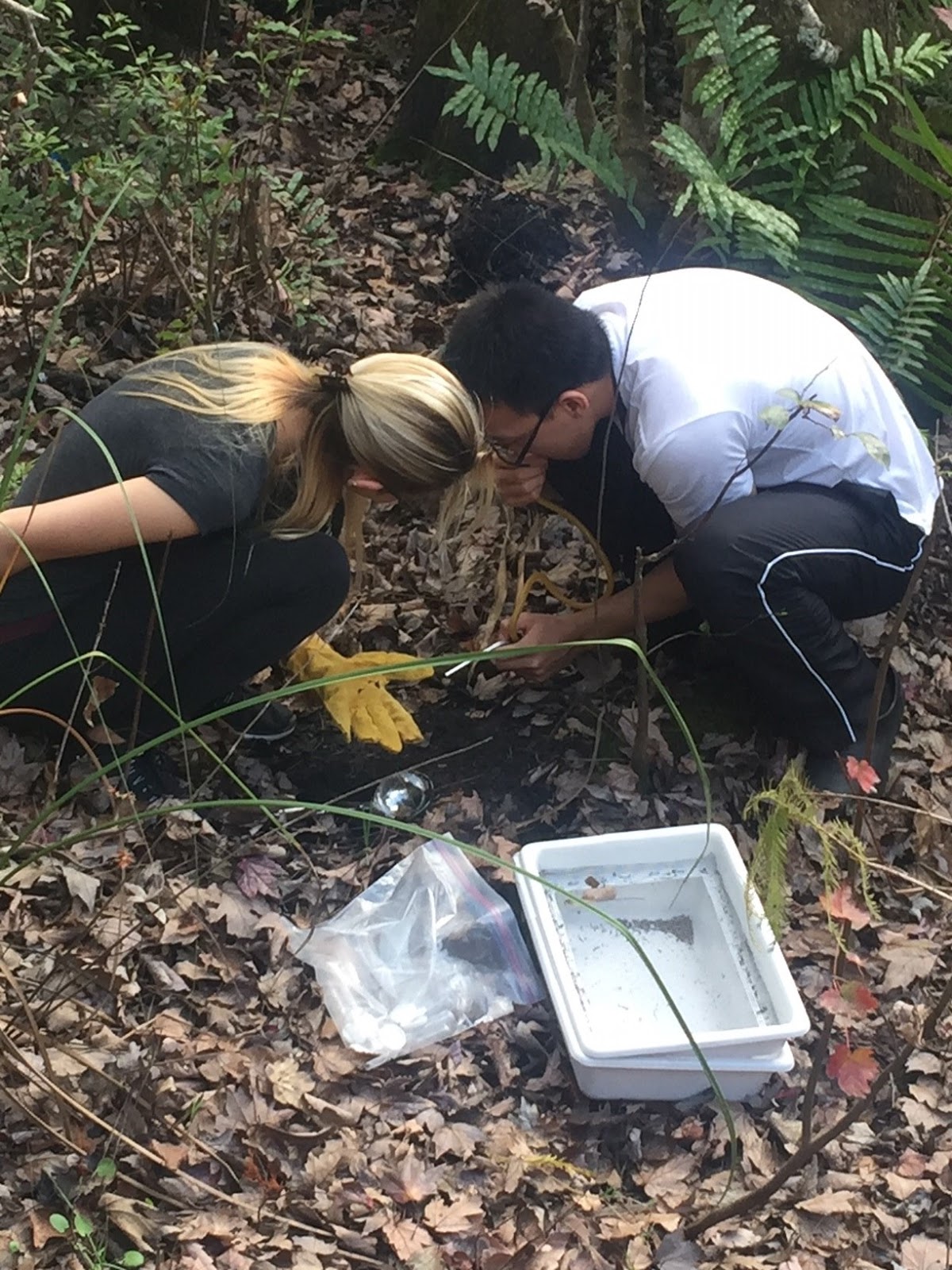


 Now being a field biologist requires some flexibility, because sometimes things go wrong out there. You also need a sense of humor. Here is a prime example…one student [who will remain nameless] used the wrong end of the ant aspirator and ingested an ant or dirt [we can neither confirm nor deny this incident]!! He was fine and the rest of us got a chuckle.


It is a big property, and more than ants live there. Last year I was lucky enough to find an animal skull. This year students were on the lookout for another…They did not disappoint. If anyone can identify it, please comment. One student also got a great photo of a snake.


All in all it was a great learning experience and it is fun to see Dr. Wetterer in action. He is very passionate about ants and makes every trip a great adventure.

Friday, January 19, 2018

Field Biology class trips

Dr. Wetterer’s BSC 4930 Field biology class gives students hands on experience by visiting local working biologists out in the field to learn about their research. Students are allowed to participate for a great hands on learning environment.

Yesterday (1/18/18) the class went to two locations. The first one was Manatee Lagoon. The students learned about the history and research being done locally with the Florida Manatee. Below are some of the pictures. When the outside temperatures fall, this FPL site is a warm water refuge.  The animals come in to regulate their body temperatures. Manatees need the temperature to stay above 68 degrees or they can begin to show signs of cold stress.
Here are some pictures from that trip.


Trip two was to the local Abacoa Greenway across from the FAU Jupiter Campus. Many of our faculty and staff are able to do field research in this spot. This day, Grad student Amanda Hipps (@biophiliamanda) took the class around to show us what she is doing with the Gopher Tortoise. Amanda is studying the ecology of the gopher tortoise symbionts [species sharing burrows of the tortoise]. Students got to participant in using burrow cameras to investigate the interior of the burrows, as well as the installation of a motion activated trail camera.

Here are some pictures of the class adventure. 


Tuesday, January 2, 2018

Meet the Scientists Lecture Series hosted by Taras Oceanographic

MEET THE SCIENTIST LECTURE SERIES 2017/2018

January 10, 2018- 7 p.m.

Biological Rhythms: Molecular Clocks to Keep Your Brain on Time    

Paul Evans, Ph.D.
Max Planck Florida Institute

Dr. Paul Evans is a postdoctoral research fellow in the lab of Ryohei Yasuda at the Max Planck Florida Institute for Neuroscience (MPFI), where he investigates the role of dopamine in learning and memory. Before coming to MPFI, Paul completed his PhD in Neuroscience in 2016 at Emory University in Atlanta, GA. 
So join us for what is surely going to be a fascinating presentation and Q&A session.                                                   Photo by Enrico Sacchetti

Program
The Meet the Scientist Lecture Series is a joint venture with the Environmental Research and Field Studies Academy of Jupiter High School. It continues to be sponsored by the Rotary Club of Jupiter and Tequesta, and the Jupiter Inlet District.

Venue
Auditorium of Jupiter High School. 500 N. Military Trail, Jupiter, FL 33458.

Free Access
All lectures are open to everyone. No RSVP required. For more information, call Stefan 561.762.6473.

Taras Oceanographic Foundation |561-762-6473| harzen@taras.org |www.taras.org

Friday, December 1, 2017

Dr. James Wetterer's  PCB 2174 Honors Behavioral Ecology  class took students  on a field trip to learn about minature horses used as therapy horses. One of the students in the class, allowed us to visit her family home and stables.

Here are a few images. They also have many other horses, and a goat! I am determined to find a way to get a goat for the library as a therapy animal! Afterall, there is such a thing as library cats, so why not library goats!!

Here are a few more links to read up on the subject of mini therapy horses:

http://mini-horse.org/miniature-horses-therapy-animals/ 

http://www.equitrekking.com/articles/entry/miniature-horses-as-therapy-animals/ 

https://nypost.com/2014/12/04/therapeutic-mini-horses-offer-comfort-to-ailing-patients/


Wednesday, November 8, 2017

Combating disease with killer mosquitoes

.

 Dennis Kunkel Microscopy/SPL
The lab-grown mosquitoes developed by MosquitoMate seek to eliminate the disease-carrying Asian tiger mosquito (Aedes albopictus, shown here). [Excerpted from 10.1038/nature.2017.22959]

In attempts to fight the Asian tiger mosquito, an invasive species that spreads diseases like zika, the Environmental Protection Agency approved the use of Wolbachia pipientis, a bacterium that can infect and eliminate this species of mosquito. A biotech company [Mosquito Mate] will raise male mosquitoes, infected with the bacterium and release them in 20 states. The infected males will mate with the female Asian Tiger species. The females will lay eggs that will not hatch, eventually killing of the species.

“The EPA decision excludes much of the southeastern United States, which is home to dense populations of mosquitoes and a long mosquito season, because MosquitoMate did not conduct field trials there” [Waltz, 2017].

To read more about this experiment and trial release of mosquitoes, follow the links below.


EPA:  EPA Grants Extension of Experimental Use Permit for ‘Wolbachia Mosquito’


Grist: The U.S. plans to use killer mosquitoes to fight disease

I have included links to descriptions of the various viruses that are carried by the Asian tiger mosquito.


Wednesday, November 1, 2017

What is lurking in flood waters following a natural disaster?

                                                       Image credit: LM Otero/Associated Press

The recent Hurricanes [in Florida, Puerto Rico, Houston and other areas] brought many unseen hazards to people affected by flood waters. These waters mix with everything on and under the ground. Industrial solvents and chemicals, animal waste, sewage and pesticides get washed into the flood waters; not to mention sharp objects and unexpected wildlife [snakes, alligators, ants, and rats—to name a few](Brodin, E., 2017).

For those that must wade through and interact in these waters there is potential for spread of diseases and infection. Some of those can be very serious. A few of these potential hazards include leptospirosis, ecoli and vibrio.

Below is a short list of a few resources on the topic. Click on the links to learn more about the dangers lingering in flood waters around the world.

Internet Resources

Brodin, E., 2017. Scientists warn that floodwaters from Hurricane Harvey still pose a lingering threat — here’s what to watch out for. Business insider. Online. Available at: http://www.businessinsider.com/hurricane-harvey-floodwater-dangerous-tetanus-2017-8 [Accessed on 11/1/2017]

Kaplan, S. & Healy, J., 2017. Houston’s Floodwaters Are Tainted, Testing Shows. New York Times, Online. Available at: https://www.nytimes.com/2017/09/11/health/houston-flood-contamination.html?_r=0 [Accessed on 11/1/2017].

World Health Organization, 2012. Leptospirosis. Online. Available at: http://www.wpro.who.int/mediacentre/factsheets/fs_13082012_leptospirosis/en/ [Accessed on 11/1/2017].

Peer reviewed Journal articles:

Ko AI et al., 1999.  Urban epidemic of severe leptospirosis in Brazil. Lancet. Sep 4 354 820 825 
PubMed abstract (Free)  Web of Science

Socolovschi, C., et. al, 2011. Strikes, flooding, rats, and leptospirosis in Marseille, France. International Journal of Infectious Diseases. 15 (2011) e710-e715. http://dx.doi.org/10.1016/j.ijid.2011.05.017

Ayral, F., et. al., 2015. Distribution of Leptospira interrogans by Multispacer Sequence Typing in Urban Norway Rats (Rattus norvegicus): A Survey in France in 2011-2013. PLos One. https://doi.org/10.1371/journal.pone.0139604 [Accessed on 11/2/2017].
