Friday, March 15, 2019

CBD oil and veterinary use


An article published this week in the Detroit Free Press, by Kathleen Gray, Pot for pets: Here's how vets and others say it can help, discusses the gray area of CBD infused oils for both human and animal treatment. With the passing of the farm bill last year, regulation guidelines are still being developed. When it crosses over into the veterinary field, it becomes more complicated. Each state has their own laws and many veterinarians are not legally allowed to talk about this treatment.

Scientific research with CBD oil on animals is still in its infancy, but seems to be showing promising results. The Free Press article mentions a study by Cornell University's College of Veterinary Medicine which shows progress for pain relief while Colorado State University has a clinical trial with positive results of treating epileptic dogs with CBD.


To read the full article from the Detroit Press, please follow this link.

More resources on the subject: 

Cornell University College of Veterinary Medicine

Colorado State CBD clinical trials 


Photo provided by Diane Arrieta

Friday, March 1, 2019

Feature Friday: Dr. Ken Dawson-Skully

Today we are going to look at one of our very own professors.
          • Associate Professor
          • FAU Biological Sciences
          • 561 297-0337 (Boca Raton)
          • ken.dawson-scully@fau.edu
          • Boca Raton - SC, 214


Instead of trying to explain all the amazing things he and his lab are doing, we decided to post a link to a podcast done by People behind the Science Podcast . They feature academic and industry experts in varying fields of science. The podcasts provide a glimpse into their lives and provide easy explanations of current research in science.

Take a listen [Click on link]

218: Dr. Ken Dawson-Scully: The Science Behind the Survival Skills of Cells Under Stress


You can view all of Dr. Dawson-Skully's publications and his google scholar profile at this link

If you are an FAU student, you can search these publications from our e-resources right from the library home page.


Tuesday, July 10, 2018

Awareness of rabies and response to dog bites in Bangladesh


Photo Credit: CDC/Barbara Andrews


Veterinary Medicine and Science recently published an  interesting article about rabies and treatments for both humans and animals in Bangladesh. 

It is interesting to compare the differences of rabies cases and treatments between the United States and Bangladesh. According to the Center for Disease Control, more than 90% of all animal cases reported annually to CDC [in the United States] now occur in wildlife; before 1960 the majority were in domestic animals. The principal rabies hosts today are wild carnivores and bats. In Bangladesh, the source is domestic and feral dogs. The number of rabies-related human deaths in the United States has declined from more than 100 annually at the turn of the century to one or two per year in the 1990’s [CDC, 2018].

Below is an excerpt from the article.

Rabies is an invariably fatal viral zoonotic disease that can infect all mammals, but domestic dogs are the source of over 99% of human infections (WHO, 2013). Worldwide, an estimated 29 million people receive postexposure prophylaxis (PEP) for rabies each year and more than 59 000 people die of rabies (Hampson et al2015), primarily due to poor rabies control measures. Human rabies can be prevented through immediate administration of PEP following exposure to rabid animals (Hemachudha et al2002). However, people in lowincome countries, especially the poor portion of society, may not receive these lifesaving treatments because either the PEP treatment is expensive and not readily available or people may not visit the hospital to receive treatment due to lack of knowledge about rabies (Kayali et al2003; Knobel et al2005; Hampson et al2008) [Gosh, et a;., 2016]

References:
CDC [Center for Disease Control]. Rabies in the U.S., online. [Accessed on 7/10/2018]. Available at: https://www.cdc.gov/rabies/location/usa/index.html

Sumon Ghosh  Sukanta Chowdhury  Najmul Haider  Rajub K. Bhowmik  Md. S. Rana Aung S. Prue Marma  Muhammad B. Hossain  Nitish C. Debnath  Be‐Nazir Ahmed, 2016. Veterinary Medicine and Science. 2:3. Pp.161-169 https://doi.org/10.1002/vms3.30 
  
Photo Credit: Content Providers: CDC/Barbara Andrews - This media comes from the Centers for Disease Control and Prevention's Public Health Image Library (PHIL), with identification number #2614. Note: Not all PHIL images are public domain; be sure to check copyright status and credit authors and content providers., Public Domain, https://commons.wikimedia.org/w/index.php?curid=3838566

Wednesday, June 27, 2018

Blue Green algae is dangerous for animals and humans

                                                                                   [image credit FWC, 2018]


Living in South Florida, we are all too familiar with the blue green algae that can be found today in all of Florida's freshwater and brackish habitats – lakes, rivers and estuaries. This blue green algae, also known as Cyanobacteria can cause health issues for both humans and animals.

Nutrient pollution from agricultural and urban runoff causes the majority of freshwater cyanobacteria blooms. Other conditions that contribute to blooms are stagnant water resulting from a lack of natural flushing and land clearing. Cyanobacteria blooms can destroy submerged vegetation like seagrass by blocking sunlight. Blooms can also reduce oxygen availability to other aquatic organisms and introduce toxins that pass through the food chain. Toxins produced by cyanobacteria can be harmful to humans, affecting the liver (hepatotoxins), the nervous system (neurotoxins) and skin (dermatotoxins) [FWC, 2018].

Veterinary toxicologist, Steve Ensley, stated that when animals are exposed to this toxin, they may experience vomiting or diarrhea. If the cyanobacteria exposure is severe, it can be lethal and cause liver failure in animals [Anderson, 2018]. Animals should be kept away from any waters thought to have this algae present and livestock ponds should be monitored on a regular basis.

For more information on Cyanobacteria and water pollutants, you can follow the links below: [accessed on 6/27/2018]


Friday, June 8, 2018

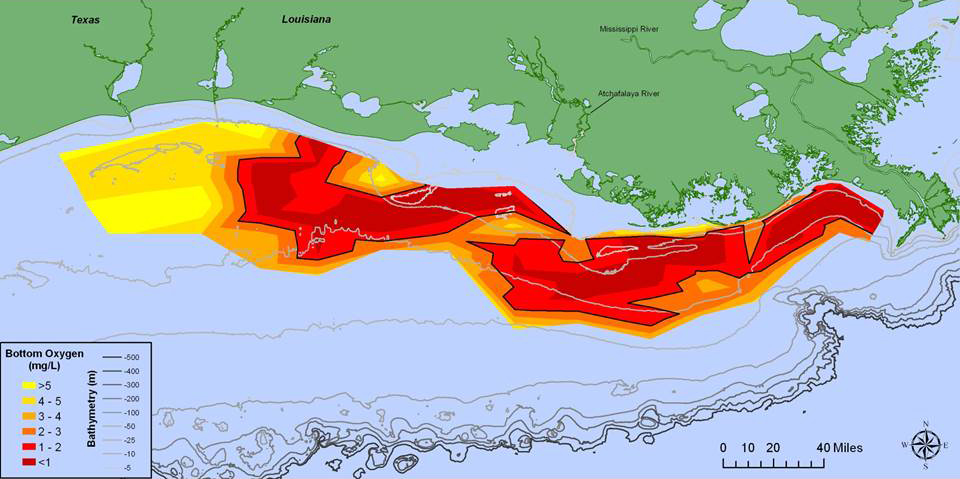
Dead zone in the Gulf of Mexico is growing larger


What is a marine dead zone? Also known as hypoxia, it is an area in the ocean with such low oxygen concentration that animal life suffocates and dies, hence the name dead zone. “Hypoxic zones can occur naturally, but scientists are concerned about the areas created or enhanced by human activity (NOAA). 

There are many physical, chemical, and biological factors that combine to create dead zones, but nutrient pollution is the primary cause of those zones created by humans. Excess nutrients that run off land or are piped as wastewater into rivers and coasts can stimulate an overgrowth of algae, which then sinks and decomposes in the water. The decomposition process consumes oxygen and depletes the supply available to healthy marine life” [NOAA https://oceanservice.noaa.gov/facts/deadzone.html ].

Scientists predict that the Gulf dead zone will cover about 6,620 square miles of the bottom of the continental shelf off Louisiana and Texas. The Gulf dead zone is the second largest HUMAN CAUSED one in the world. Science daily reported that “Efforts to reduce the nitrate loading have not yet demonstrated success at the watershed scale” 
[https://www.sciencedaily.com/releases/2018/06/180607120724.htm ]. The dead zone is present all year long, but is most prevalent during spring and summer, citing nutrients from the Mississippi River watershed contribute to the problem.

To read the full report go to Science Daily story here.


Map showing distribution of bottom-water dissolved oxygen from July 28 to August 3, west of the Mississippi River delta. Black lined areas — areas in red to deep red — have very little dissolved oxygen. (Data: Nancy Rabalais, LUMCON; R Eugene Turner, LSU. Credit: NOAA)

Tuesday, May 15, 2018

New emerging global coronavirus in pigs has the potential to transmit to humans.


Image: By Johan Spaedtke - Own work, CC0, https://commons.wikimedia.org/w/index.php?curid=26954959

The Porcine deltacoronavirus (PDCoV), identified in 2012, is a common enteropathogen of swine with worldwide distribution. The evolutionary cycle/origin of this virus is still unknown.  The PDCoV has predominantly been associated with avian CoV. Analysis suggests that PDCoV has experienced a host-switching event between birds and mammals.
The porcine deltacoronavirus (PDCoV) (species name coronavirus HKU15) was identified in Hong Kong in pigs in the late 2000s  and has since been detected in swine populations in various countries worldwide (Wentao, et al., 2018). The virus can cause acute diarrhea and vomiting, and can sometimes be fatal.

Due to the presumed origin in avian species and the known cross-species transmission of CoVs, researchers began to investigate the susceptibility of cell lines other than swine to this PDCoV infection. They began to test cell lines derived from human and galline tissues. They found both were susceptible to PDCoV infection

“Successful cross-species transmission depends foremost on the virus’ ability to bind and functionally use a receptor within an alternative host, causing the S protein to be the driver of CoV emergence” (Wentao, et. al, 2018). Due to the fact that pigs are the second largest global livestock species, and the potential for them to spread zoonotic diseases; this study sheds light on the importance of further study.

To read the FULL STUDY on this research please follow the link at PNAS here: https://doi.org/10.1073/pnas.1802879115

Reference:

Wentao Li, Ruben J. G. Hulswit, Scott P. Kenney, Ivy Widjaja, Kwonil Jung, Moyasar A. Alhamo, Brenda van Dieren, Frank J. M. van Kuppeveld, Linda J. Saif, and Berend-Jan Bosch, 2018. Broad receptor engagement of an emerging global coronavirus may potentiate its diverse cross-species transmissibility