Join and learn about conservation photography at Riverwoods Field Lab.
Friday, March 30, 2018
Friday, March 23, 2018
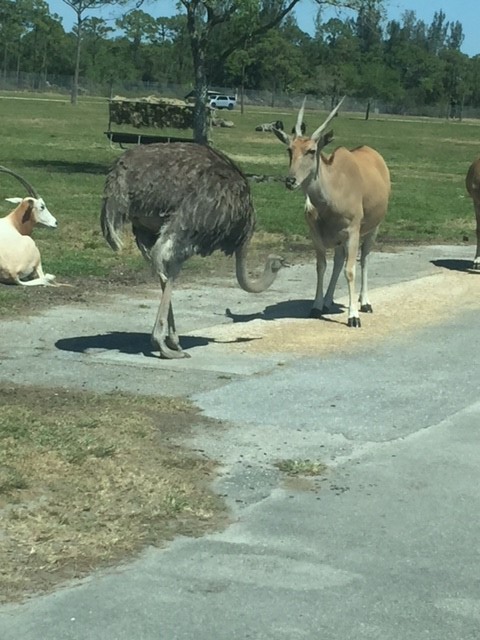
Field Biology class visits Lion Country Safari
Tina Cloutier Barbour, Curator of Primates at Lion Country Safari, gave the class a
tour of the drive through safari and then an in depth look at chimpanzees at
the park. You can learn more about their
chimps here and the ongoing research through the chimpanzoo program.
Tina talked about all the history and management efforts
that are ongoing in each section of the safari, as we drove through. It was
informative and interesting to get a behind the scene talk for each species we
encountered. She spoke of all the regulations, breeding management, enrichment
and enclosure efforts that are ongoing in the park. We learned about behavioral
quirks for some of the species and how the staff handles them, efforts to
improve the natural habitats of the animals and future plans and research that
are in the works.
We then stopped at the research station for the chimpanzees,
Tina’s specialty and main responsibility at Lion Country Safari.
Lion Country Safari is home to one of the largest displays
of wild chimpanzees in North America. Their four island habitats are home to
several generations of chimpanzees, which trace their roots back to east
Africa. Though some of our chimpanzees are former house pets and actors, many
have been born at Lion Country Safari and they are now all fully integrated
into the complex social structure of each island troop and may be considered
wild.
Friday, March 16, 2018
Field Trip Friday: Snook survey
Field biology class spent the afternoon with Fish and Wildlife biologists learning how to cast seine net and survey snook in the Indian River Lagoon at the Hobe Sound National Wildlife Refuge. First, biologist Jim Whittington, gave students an overview of what and why they do snook surveys. The stock assessment report for common snook provides updated life histories, biology and fishery information, as well as commercial landings, recreational catch, and additional statistical information.
This class trip is always voted class favorite every year. Along with the FWC survey, students participated in a student thesis data collection project on e-Dna (environmental DNA). The student (Ryan Anderson) was collecting water samples to test out the practice of collecting e-Dna as a method for determining the presence of certain species in the water without having to catch or handle them directly. Here are John, Will and Ryan braving the chilly water in the name of science!
The rest of the class went straight to the fish survey. They learned how to cast and haul in the net, separate and release fish, and how to measure are record data on the targeted snook species. Below is a short video and pictures of the class adventure. Along with Jim Whittington, Anderson Berry, Derek Cox and Joy Young all helped the students particpate in the snook surveys.
Thanks to the Florida Fish and Wildlife Research Institue for allowing us to participate and learn all about snook management and research.
Wednesday, March 14, 2018
Dupuis Management Area field trip
Recently Wilkes Honors College Faculty went on a tour of The Dupuis Managent Area to investigate possible research opportunities for students.
The DuPuis Management Area is a 21,875-acre multi-use natural area located in northwestern Palm Beach and southwestern Martin counties. The property is interspersed with numerous ponds, wet prairies, cypress domes, pine flatwoods and remnant Everglades marsh. The area provides miles of hiking and horseback trails, an equestrian center, graded vehicle roads, backpack and group campsites and seasonal hunting. DuPuis is far from urban areas, and its dark night sky lends itself to excellent stargazing.
Kim Elliot, the Education and Training Coordinator for CES/FAU located at Dupuis, along with Loisa Kerwin, Assitant Director for CES/FAU gave a short presentation on the history, ecology and activities that are available at Dupuis. They highlighted the research done on the Red Cocaded Wooddpecker by The Florida Freshwater Fish and Wildlife Commission (FWC) scientist, Valerie Sparling. You can read about that here.
The DuPuis Management Area is a 21,875-acre multi-use natural area located in northwestern Palm Beach and southwestern Martin counties. The property is interspersed with numerous ponds, wet prairies, cypress domes, pine flatwoods and remnant Everglades marsh. The area provides miles of hiking and horseback trails, an equestrian center, graded vehicle roads, backpack and group campsites and seasonal hunting. DuPuis is far from urban areas, and its dark night sky lends itself to excellent stargazing.
Kim Elliot, the Education and Training Coordinator for CES/FAU located at Dupuis, along with Loisa Kerwin, Assitant Director for CES/FAU gave a short presentation on the history, ecology and activities that are available at Dupuis. They highlighted the research done on the Red Cocaded Wooddpecker by The Florida Freshwater Fish and Wildlife Commission (FWC) scientist, Valerie Sparling. You can read about that here.
They treated us to a SWAMP BUGGY RIDE so we could get a close up view of the different habitats on the property. Here are a few shots of us preparing for the journey.
If you have never experienced a swamp buggy, don't worry I took video!
Dupuis is a great resource for so many acitivities. Here are a few more pics of the day. We got out and walked throught the cypress swamp. You can see the water line on the trunks of the trees. There is also a close up of the Florida Apple snail.
To end our tour we stopped at the public campground area. There are remnants of history there with the old hunting camp owned by John G. and Susan H. DuPuis, Jr. If you are up for an adventrue this is a great place to start.
Friday, February 23, 2018
Field Trip Friday: Florida Oceanographic Society and CSA Ocean Sciences, Inc.
Field biology continues with a two for one field trip day! We
visited the Florida Oceanographic
Society and then CSA Ocean Sciences,
Inc. in Stuart, FL.
Dr Vincent Encomio gave us an overview of his work with Oyster
restoration and Dr. Katie Tiling [former Wilkes
Honors College student and PhD alumnus from FAU]
explained her work with seagrass restoration. Both explained the concept of living
shorelines. Below is information about what we learned.
The following information has been excerpted from their website.
The Florida Oceanographic Society is leading efforts in
research, monitoring and restoring habitats in South Florida, particularly in
the southern portion of the Indian River Lagoon. The Indian River Lagoon is
North America’s most bio-diverse estuary, home to more than 4,300 species of
plants and animals, including 36 rare and endangered species.
Vincent Encomio, PhD, Research Scientist,
spearheads the effort to restore the oyster population devastated by
fresh-water discharges into the estuary that began in 2005 and continues today!
The oysters are critical to cleaning the water and providing habitat and food
for up to 300 estuarine species.
The FL.O.O.R. (Florida Oceanographic Oyster
Restoration) program actively engages the public in restoring oyster reef
habitat. With the aid of thousands of volunteers, FL.O.O.R. restores oyster
habitat by recycling shell, constructing reefs and growing oysters.
F.O.S.T.E.R.’s
goal is to restore seagrass populations into our estuary impacted by
fresh-water discharges and algal blooms. Seagrasses are vital to the health of
Florida’s waterways as it provides habitat, nurseries, and food for a variety
of estuarine species. In Florida, we have the highest seagrass biodiversity of
the continental USA with seven species!
The
F.O.S.T.E.R. program relies on community-based restoration efforts to restore
seagrass habitat. With a growing volunteer base, F.O.S.T.E.R. restores seagrass
by collecting and growing seagrass fragments in nurseries, constructing
seagrass planting units, and transplanting living seagrass into the estuary.
Part two of our trip took us to CSA Ocean Sciences, Inc. Mary Jo Barkaszi, who is the Marine Mammal Programs Manager gave us a company overview and then
specifics of her work with
marine mammal acoustics.
CSA Ocean Sciences, Inc [from
their website]
CSA
Ocean Sciences Inc. (CSA) specializes in multidisciplinary projects concerning
potential environmental impacts of activities throughout the world and offers a
wide variety of desktop and field survey services. CSA is headquartered in
Stuart, Florida, with regional offices in Tampa, Florida; Houma, Louisiana;
Salinas, California; Houston, Texas; Port-of-Spain, Trinidad; Doha, Qatar; Rio
de Janeiro, Brazil and Perth, Australia.
OCEAN SOUND EXPERTISE
Ocean sound is a complex issue—CSA understands ocean sound.
Whether it is detection and classification of marine species, noise
measurement, sound propagation, predictive modeling, or soundscape
characterization; we take the approach that one size does not fit all. CSA uses
the best available science and technologies to develop risk-minimizing results
with a suite of solutions from simple to complex. Ocean sound issues are large
in scale both temporally and spatially, but also have many short-term, acute
components, which is why CSA approaches this problem at a habitat or soundscape
level. Ambient noise in the ocean will fluctuate greatly depending on both
natural and man-made contributions within a region’s soundscape. Short-term
measurements do not provide an accurate assessment of regional changes due to
cumulative variations to sound levels, but can be useful in identifying
specific contributors. To provide an accurate level of change detection,
long-term monitoring is necessary in order to quantify the contributions of
each source. At the same time, monitoring is required to ensure that the
shorter-term, acute contributions are minimized. The timing of deployment is
crucial in that the data collection occurring before, during, and after an
influx of operations will provide the greatest return on the analysis. These
acoustic data can be used to provide long-term information about the local
soundscape and the activities that presently occur and, furthermore, can be
used as a benchmark for comparison with a future soundscape.
Please
follow the links to their website to learn about everything they are doing all
over the world.
Field Trip Friday was again a huge success. It is interesting to find out what
science is going on close to campus and the resources available to the
students.
Friday, February 16, 2018
Field trip Friday: Grassy Waters Everglades Preserve
Our field trip adventures for Honors Field Biology led us to the Grassy Waters Everglades Preserve for a day of canoeing and mucking in the mud [dip netting] looking for treasures. Our field guide, Sarah is an excellent naturalist and spoke on a wide variety of topics [ecology, geology, history, wetland chemistry, and more]. It was very informative.
Grassy Water is a protected 24 square mile wetlands ecosystem on the northeastern edges of the Florida Everglades system. It serves as the fresh water supply for the city of West Palm Beach and other towns nearby.
It is a fun place to visit. They also have a great boardwalk and education center, for those not wanting to get in the water.
Here are the pictures of our day out in the field.
Grassy Water is a protected 24 square mile wetlands ecosystem on the northeastern edges of the Florida Everglades system. It serves as the fresh water supply for the city of West Palm Beach and other towns nearby.
It is a fun place to visit. They also have a great boardwalk and education center, for those not wanting to get in the water.
Here are the pictures of our day out in the field.
This is where we parked the canoes and went to try out our dip netting skills to see what lives in the mud. We put our catches in buckets then went to analyze them. Some of our finds included crayfish, dragonfly larvae, tadpoles and small fish. Don't worry, everything was released back into the water! Another successful trip. Thanks Dr. Wetterer.
Subscribe to:
Posts (Atom)