Friday, February 16, 2018

Field trip Friday: Grassy Waters Everglades Preserve

Our field trip adventures for Honors Field Biology led us to the Grassy Waters Everglades Preserve for a day of canoeing and mucking in the mud [dip netting] looking for treasures. Our field guide, Sarah is an excellent naturalist and spoke on a wide variety of topics [ecology, geology, history, wetland chemistry, and more]. It was very informative.

Grassy Water is a protected 24 square mile wetlands ecosystem on the northeastern edges of the Florida Everglades system. It serves as the fresh water supply for the city of West Palm Beach and other towns nearby.

It is a fun place to visit. They also have a great boardwalk and education center, for those not wanting to get in the water.

Here are the pictures of our day out in the field.


This is where we parked the canoes and went to try out our dip netting skills to see what lives in the mud. We put our catches in buckets then went to analyze them. Some of our finds included crayfish, dragonfly larvae, tadpoles and small fish. Don't worry, everything was released back into the water! Another successful trip. Thanks Dr. Wetterer. 


Friday, February 9, 2018

Field Biology class takes a tour of Jupiter Environmental Labs


The Wilkes Honors College Field Biology class, taught by Dr.  James Wetterer took a trip to Jupiter Environmental Labs and learned about all the interesting projects they do and got a firsthand look at analytical chemistry from chemist and owner Ed Dabrea.

Along with standard environmental testing, this lab also is involved in several special projects. Their website states some of them are:

Pharmaceuticals & Personal Care Products (PPCPs) and Endocrine Disruptors
Jupiter Analytix provides testing for PPCPs and Endocrine Disruptors. This testing is done by the latest generation HPLC/MS/MS, providing the lowest detection limits available for these emerging substances of concern (ESOC).

Real-Time Drug Monitoring Program
Jupiter Analytix provides schools with Real-Time Drug Monitoring (RTDM) — the first and only unobtrusive drug identification and measurement program of its kind. Educators will know what kind, how much, sudden increases, when usage changes, and if new drugs are being introduced to the student body. RTDM empowers educational systems with information to achieve a safe, drug-free environment so our children can thrive.

Special Projects
Research project for the Monroe County Mosquito Control District and Adapco, Inc. on the efficacy of a larvaecide used worldwide. This project required the development of a sampling/analysis program over multiple sites. Research grade protocols were utilized to ensure the integrity of the project. Data provided by JEL to the R&D department of the manufacturer will be used in ongoing studies to improve the delivery system of this product. Long term research project for chlorine substitute product being introduced to the market. This project consisted of creating and performing a long-term field study/laboratory analysis.

Here are some images of the students learning about each lab and how all the mass spectrometers work!


We also learned that Jupiter Environmental Lab provides summer internships for local students. Some of them end up working there. Here is an example of one of our HC students who has recently been hired to work at the lab…. [David Brothers] This student graduated with his honors college thesis on Antlions. Dr. Wetterer was his thesis advisor.

It was a great trip and very interesting to see this side of the science equation. Field Biologist collect samples and send them off to labs. Students got a full picture of what happens to their samples and how involved gathering the analytical data can be. Thanks Jupiter Environmental Labs!!

Friday, February 2, 2018

A class trip to Jonathan Dickinson State Park

The Field Biology class at the Wilkes Honors College at FAU Visited the Jonathan Dickenson State Park. The park biologist [Rob Rossmanith] gave the students a talk about the 13 natural communities, including sand pine scrub, pine flatwoods, mangroves, and river swamps that are inside the park. The Loxahatchee River, Florida's first federally designated Wild and Scenic River, runs through the park. We went out into the park to see first hand, some of the plants and discuss ecology.


We learned about prescribed burning and ecosystem management done in this park. We also learned about the ecology and conservation of the Florida Scrub Jay and went on a mini survey to find some of the birds in the park. If you look closely, you can see a scrub jay in the top of the tree.


We Climbed Hobe Mountain and saw great views of the entire park while getting a lesson on history and conservation of the different habitats in the park.


After the talks and tours were concluded, we went to the part of the park along the river so students could enjoy the water. It was educational and fun to be out in the park to learn from the park biologst. 


Friday, January 26, 2018

Collecting Ant Specimens with Dr. Jim Wetterer


Last week we talked about the field biology class taught by Dr. James Wetterer. This week he took the class to FAU’s Pine Jog Environmental Education Center. Anne Henderson, the Director of Education, gave students an interactive introduction to the center and took us on a tour. It was very informative. Here are a few pics of that portion of the trip


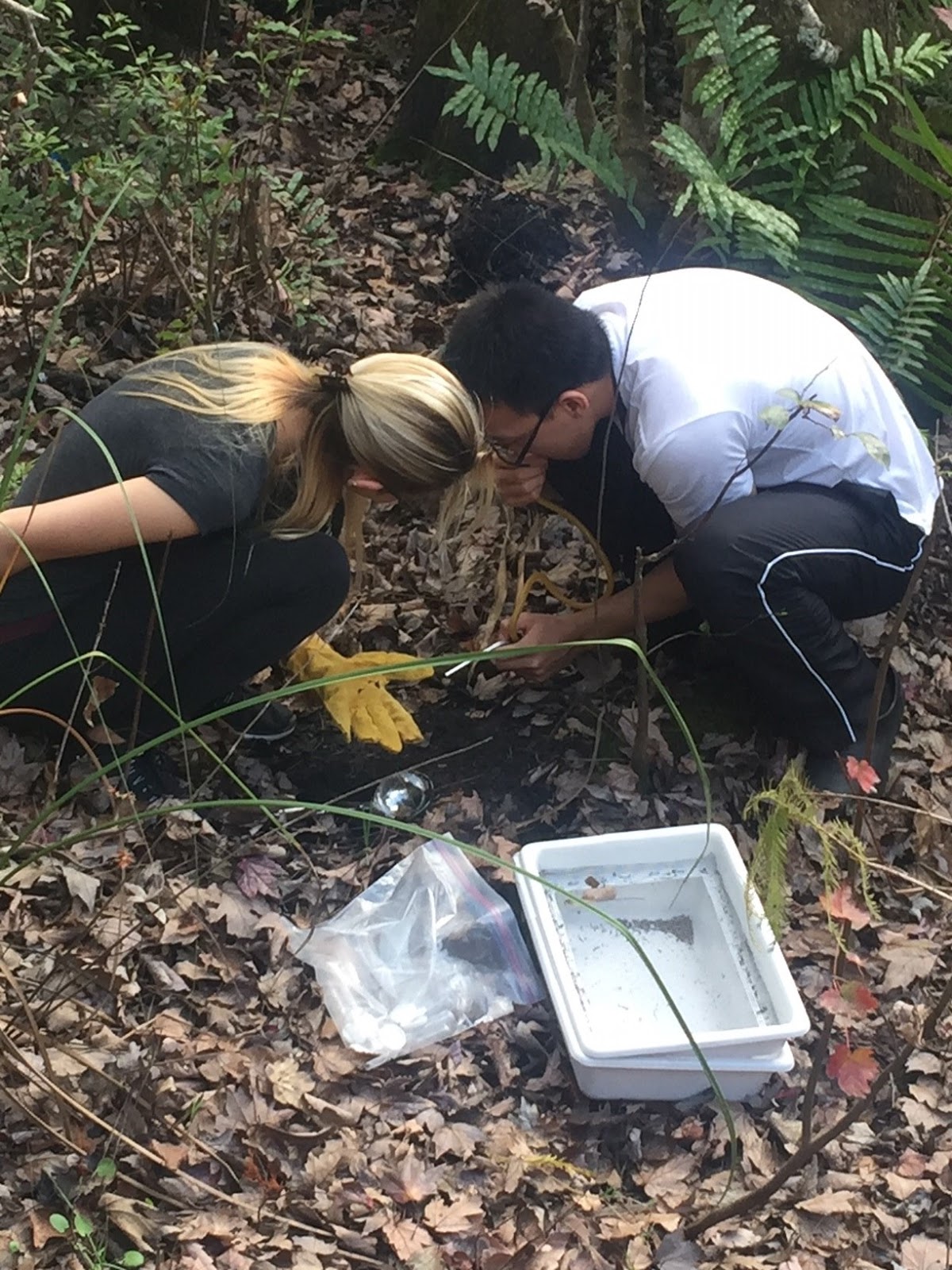
Students read peer reviewed articles, and discuss field topics in class. The next class is spent out in the field. This lab (field) class, students learned how to collect ant specimens throughout the property of the environmental center. They practiced specimen collection and identification. Once the ants were collected, Dr. Wetterer made the identifications.

Here are the students in action


 Now being a field biologist requires some flexibility, because sometimes things go wrong out there. You also need a sense of humor. Here is a prime example…one student [who will remain nameless] used the wrong end of the ant aspirator and ingested an ant or dirt [we can neither confirm nor deny this incident]!! He was fine and the rest of us got a chuckle.


It is a big property, and more than ants live there. Last year I was lucky enough to find an animal skull. This year students were on the lookout for another…They did not disappoint. If anyone can identify it, please comment. One student also got a great photo of a snake.


All in all it was a great learning experience and it is fun to see Dr. Wetterer in action. He is very passionate about ants and makes every trip a great adventure.

Friday, January 19, 2018

Field Biology class trips

Dr. Wetterer’s BSC 4930 Field biology class gives students hands on experience by visiting local working biologists out in the field to learn about their research. Students are allowed to participate for a great hands on learning environment.

Yesterday (1/18/18) the class went to two locations. The first one was Manatee Lagoon. The students learned about the history and research being done locally with the Florida Manatee. Below are some of the pictures. When the outside temperatures fall, this FPL site is a warm water refuge.  The animals come in to regulate their body temperatures. Manatees need the temperature to stay above 68 degrees or they can begin to show signs of cold stress.
Here are some pictures from that trip.


Trip two was to the local Abacoa Greenway across from the FAU Jupiter Campus. Many of our faculty and staff are able to do field research in this spot. This day, Grad student Amanda Hipps (@biophiliamanda) took the class around to show us what she is doing with the Gopher Tortoise. Amanda is studying the ecology of the gopher tortoise symbionts [species sharing burrows of the tortoise]. Students got to participant in using burrow cameras to investigate the interior of the burrows, as well as the installation of a motion activated trail camera.

Here are some pictures of the class adventure. 


Tuesday, January 2, 2018

Meet the Scientists Lecture Series hosted by Taras Oceanographic

MEET THE SCIENTIST LECTURE SERIES 2017/2018

January 10, 2018- 7 p.m.

Biological Rhythms: Molecular Clocks to Keep Your Brain on Time    

Paul Evans, Ph.D.
Max Planck Florida Institute

Dr. Paul Evans is a postdoctoral research fellow in the lab of Ryohei Yasuda at the Max Planck Florida Institute for Neuroscience (MPFI), where he investigates the role of dopamine in learning and memory. Before coming to MPFI, Paul completed his PhD in Neuroscience in 2016 at Emory University in Atlanta, GA. 
So join us for what is surely going to be a fascinating presentation and Q&A session.                                                   Photo by Enrico Sacchetti

Program
The Meet the Scientist Lecture Series is a joint venture with the Environmental Research and Field Studies Academy of Jupiter High School. It continues to be sponsored by the Rotary Club of Jupiter and Tequesta, and the Jupiter Inlet District.

Venue
Auditorium of Jupiter High School. 500 N. Military Trail, Jupiter, FL 33458.

Free Access
All lectures are open to everyone. No RSVP required. For more information, call Stefan 561.762.6473.

Taras Oceanographic Foundation |561-762-6473| harzen@taras.org |www.taras.org

Friday, December 1, 2017

Dr. James Wetterer's  PCB 2174 Honors Behavioral Ecology  class took students  on a field trip to learn about minature horses used as therapy horses. One of the students in the class, allowed us to visit her family home and stables.

Here are a few images. They also have many other horses, and a goat! I am determined to find a way to get a goat for the library as a therapy animal! Afterall, there is such a thing as library cats, so why not library goats!!

Here are a few more links to read up on the subject of mini therapy horses:

http://mini-horse.org/miniature-horses-therapy-animals/ 

http://www.equitrekking.com/articles/entry/miniature-horses-as-therapy-animals/ 

https://nypost.com/2014/12/04/therapeutic-mini-horses-offer-comfort-to-ailing-patients/